Introduction
This preview presents why the handbook exists, its purpose, intended audience and guiding principles. The complete methodology remains under development.
Why This Handbook Exists
Organisations invest significant time, effort, and resources in developing strategies, implementing projects, deploying technology, improving processes, and managing change. Despite these investments, many organisations continue to struggle with fragmentation, duplication, misalignment, poor integration, failed transformation initiatives, and unrealised benefits.
This challenge is not caused by a lack of frameworks, methodologies, standards, or best practices.
In fact, most organisations have access to an abundance of guidance, including frameworks and disciplines such as strategy management, governance, enterprise architecture, business process management, project management, service management, security management, information management, knowledge management, and performance management.
The problem is that these disciplines are often implemented independently.
Each discipline typically develops its own:
- terminology;
- taxonomy;
- reference models;
- methods;
- repositories;
- governance structures; and
- performance measures.
As a result, organisations frequently become collections of well-intentioned but disconnected practices.
The consequence is fragmentation rather than integration.
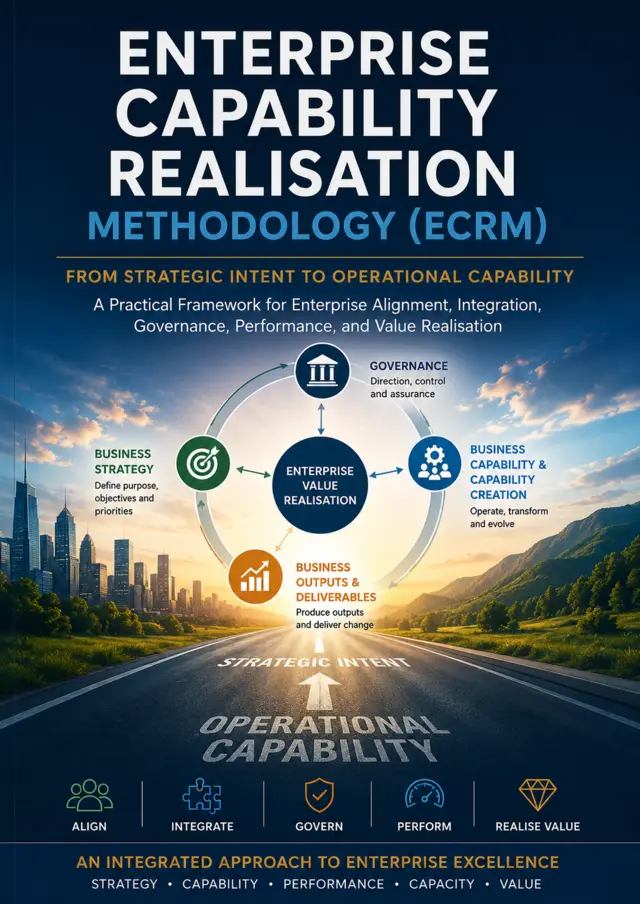
The Enterprise Capability Realisation Methodology (ECRM) was developed to address this problem.
Rather than introducing yet another discipline, framework, or methodology, ECRM provides a mechanism for aligning and integrating existing disciplines through a common ontology, a common meta-model, common governance principle, and a common capability realisation framework.
The methodology recognises that enterprises are complex systems consisting of many interconnected viewpoints, including strategy, governance, processes, information, security, performance, investment, architecture, and operations. Each viewpoint provides valuable insight into the enterprise, but no single viewpoint provides a complete understanding of the enterprise as a whole.
ECRM therefore focuses on enterprise alignment and integration.
It provides a structured approach for translating strategic intent into operational capability, measurable performance, and sustainable enterprise value.
Purpose of the Methodology
The purpose of ECRM is to provide a practical framework for:
- Enterprise Alignment;
- Enterprise Integration;
- Enterprise Governance;
- Enterprise Performance Planning;
- Capability Realisation;
- Capacity Planning;
- Investment Management;
- Change Enablement; and
- Value Realisation.
The methodology establishes traceability between:
- Mission and Vision;
- Goals and Objectives;
- Capability and Capacity;
- Processes and Activities;
- Information and Technology;
- Resources and Investments;
- Outputs and Deliverables; and
- Outcomes and Impacts.
This traceability enables enterprises to understand not only what they are trying to achieve, but also how those objectives will be realised operationally.
What Makes ECRM Different
Most enterprise methodologies focus on a single discipline. Some focus on strategy. Some focus on architecture. Some focus on projects. Some focus on processes. Some focus on technology.
ECRM focuses on the relationships between them.
The methodology is built on a fundamental principle:
Enterprise value is realised when strategy, governance, capability, processes, resources, performance, and change are aligned and integrated.
This principle forms the foundation for every framework, model, method, and practice described throughout this handbook.
Intended Audience
This handbook is intended for executives, business leaders, enterprise and business architects, process practitioners, programme and project managers, governance and performance-management practitioners, strategy and change practitioners, business analysts, solution designers, and transformation leaders.
It is particularly valuable for individuals responsible for aligning and integrating multiple disciplines within an enterprise.
Guiding Principles
- Frameworks do not create alignment—enterprises create alignment.
- Methodologies do not create integration—enterprises create integration.
- Technology does not create capability—capability is created through the coordinated application of people, information, processes, technology, assets, governance, and investment.
The purpose of ECRM is to provide the structure through which that alignment, integration, and capability realisation can occur.
Chapter-level contents
- The Enterprise Alignment and Integration Problem
- Enterprise Ontology Foundation
- Enterprise Viewpoint and Representation Framework
- Enterprise Alignment (Dimensions) Model
- Enterprise Meta-Model
- Enterprise Life Cycle Governing Principle
- Enterprise Governance Framework
- Enterprise Process Framework
- Enterprise Performance Planning Framework
- Enterprise Capability Realisation Framework
- Enterprise Investment Framework
- Enterprise Portfolio Framework
- Enterprise Capability Delivery Framework
- Enterprise Solution Realisation Framework
- Enterprise Data Reference Framework
- Operational Realisation Framework
- Enterprise Value Realisation Framework
- ECRM: The Integrated Enterprise Paradigm
Book preview © 2026 Eduan du Buisson, writing as Icky du Buisson. Published by Ashloh. All rights reserved.