This manuscript-derived public article is adapted from the developing handbook Enterprise Capability Realisation Methodology. It provides conceptual orientation and does not replace the integrated methodology, detailed frameworks or book figures.
The enterprise integration problem
Organisations invest in strategies, projects, technologies, process improvement, governance and change. Many still experience duplication, fragmented decisions, failed transformation and benefits that never materialise. The problem is seldom the complete absence of methods. It is that capable disciplines are frequently applied through different terms, models, repositories, governance arrangements and measures, without an integrating enterprise context.
The enterprise is more than its disciplines
Strategy, governance, architecture, process, information, investment, delivery, operations and performance each provide a necessary view. None is the enterprise as a whole. When a specialist viewpoint is treated as the complete reality, local optimisation can weaken enterprise coherence. ECRM treats the enterprise as an interconnected system whose parts must be understood through their relationships.
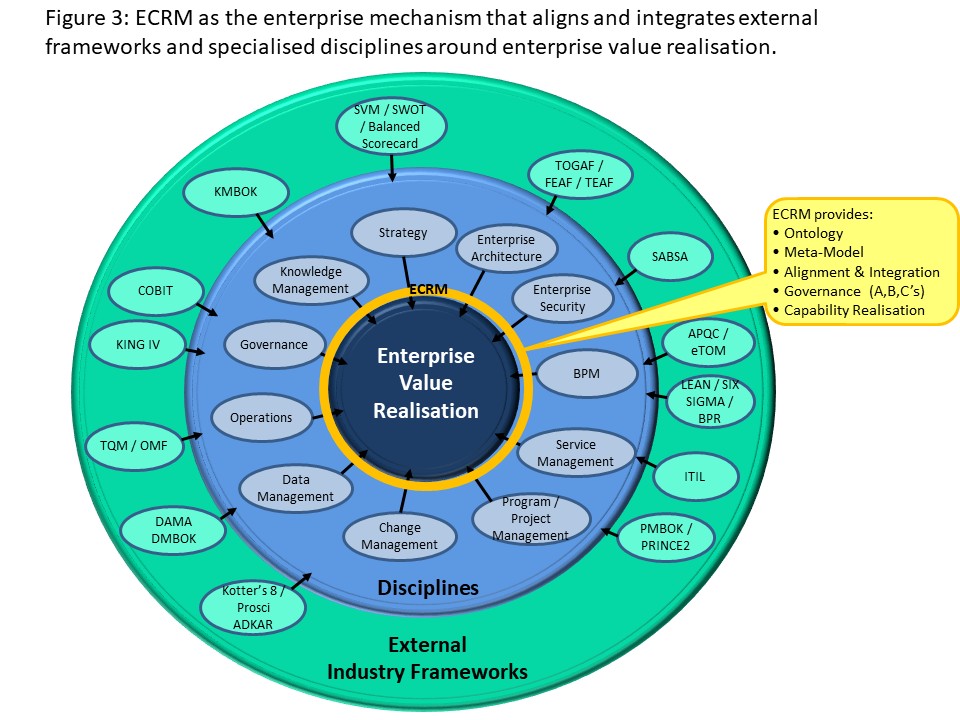
ECRM does not replace the disciplines or their external frameworks. It supplies the shared ontology, meta-model, alignment, governance and capability-realisation mechanisms needed to use them coherently in the enterprise context.
Open full-size diagram ↗Shared meaning before shared action
Alignment becomes unstable when the same term carries different meanings or different terms conceal the same concept. An enterprise ontology establishes explicit meanings for important enterprise objects and relationships. It does not replace the language of every discipline. It creates a translation and integration layer through which those disciplines can participate in one enterprise conversation.
Viewpoints and representation levels
Different stakeholders ask different questions and require different representations. Executives, process practitioners, architects, programme managers, information specialists and operational leaders do not need identical views. ECRM separates the viewpoint from the level of representation so that contextual, conceptual, logical and physical views can remain distinct while still referring to the same enterprise objects.
Five dimensions of alignment and integration
Enterprise alignment and integration require more than a common process or a collection of frameworks. ECRM examines the interaction of method, form, infrastructure, content and governance. Together, these dimensions provide the means to align enterprise intent and activity, integrate knowledge and operating components, and manage change across their lifecycle.
Change can fail when one dimension advances while another is absent or contradictory: a sound method without usable information, content without an appropriate form, a model without governance, technology without an operating method, or information without a controlled lifecycle and supporting repository.
The meta-model as an alignment and integration mechanism
The enterprise meta-model provides the common semantic structure through which the relevant components of external frameworks and specialised disciplines can be incorporated, aligned and integrated into a single enterprise model. It defines enterprise objects such as mission, vision, goals, objectives, capability, function, process, activity, information, role, capacity, service, investment and benefit, together with the relationships between them.
Its value lies not in producing another isolated catalogue, but in establishing shared meaning and making relationships explicit across frameworks, disciplines and enterprise viewpoints. Traceability then allows the enterprise to determine what an investment enables, which activities realise a capability, what information those activities consume and produce, and how operational results connect to intended outcomes.
Within the infrastructure dimension, the meta-model provides the conceptual and logical foundation for the repository or database design. The infrastructure stores and manages instances of the enterprise objects and relationships defined by the meta-model, creating an integrated body of enterprise knowledge that can support alignment, analysis, governance and managed change.
From why to how
The Enterprise Life Cycle governing principle moves from why, to what, to with what, to how. Purpose and strategic intent establish why change is required. Required outcomes and capabilities clarify what must exist. Resources, information, people, technology, assets and investment show with what it can be realised. Processes, activities, programmes, projects and operations explain how it is delivered and sustained.
Capability is realised through coordinated means
Technology alone does not create enterprise capability. Capability emerges through the coordinated application of people, information, processes, technology, assets, governance and investment. Capacity determines how much the capability can produce under defined conditions. ECRM therefore connects capability design, capability creation, operational readiness, performance and capacity rather than treating them as independent concerns.
Governance connects decisions across the lifecycle
Governance is not an approval event added at the end of design. It establishes decision rights, accountability, controls, measures and feedback across the enterprise lifecycle and explicitly across the strategic, tactical and operational dimensions of the enterprise.
ECRM uses governance to connect decisions and direction at these levels with the relevant areas of concern, required building blocks, and the entities and relationships through which decisions are made, implemented, monitored and corrected. This helps maintain traceability and alignment from strategic intent through tactical coordination to operational execution.
From operational output to sustainable value
Delivery is not complete when a project produces a solution. The solution must become operationally usable, the capability must perform at the required capacity, outcomes must be observed and benefits must be tested against the original intent. Feedback turns experience into enterprise learning and informs renewed strategy, investment and improvement. Sustainable value therefore depends on a closed loop rather than a one-way implementation chain.
The human governance connection
ECRM is not presented as a Biblical methodology. Enterprises are nevertheless led, managed and operated by people whose worldview, character and principles affect decisions and consequences. Commitments to truth, justice, stewardship, service, responsibility and regard for others should support healthier outcomes for customers, suppliers, staff and other stakeholders. A structurally integrated enterprise can still cause harm if the people governing it pursue distorted ends.
A practical enterprise reflection
Ask where strategic intent loses traceability. Do functions use the same enterprise terms? Which viewpoint is being treated as the whole? Can every major investment be connected to a required capability, operational owner, capacity requirement, performance measure and intended benefit? Where does feedback return to governance and strategy? These questions reveal whether the enterprise is operating as one system or as a collection of disconnected practices.
The next step
The ECRM handbook develops the ontology, viewpoint and representation framework, alignment dimensions, enterprise meta-model, lifecycle principle, governance, process, performance, capability, investment, delivery, solution, data, operational and value-realisation frameworks in depth. The public pathway provides orientation. The handbook will remain the integrated methodological work.