Introduction
This preview presents the book’s purpose, central premise and scope. The manuscript remains under development, and the complete book will remain the authoritative integrated work.
Every person lives within a continuous stream of experiences, decisions, and consequences. From the smallest daily choices to the most significant life decisions, human beings constantly process information, evaluate options, and act within the world around them. Yet despite the central importance of these processes, most people have never been taught how to understand, examine, or intentionally govern the internal mechanisms that shape their thinking and behaviour.
We often attribute the outcomes of our lives primarily to external circumstances—events, opportunities, or constraints beyond our control. While these factors certainly influence us, they do not fully explain the wide differences in how individuals respond to similar situations. Two people may experience the same event yet react in profoundly different ways. One response may lead to growth, wisdom, and stability, while another may lead to confusion, conflict, or decline.
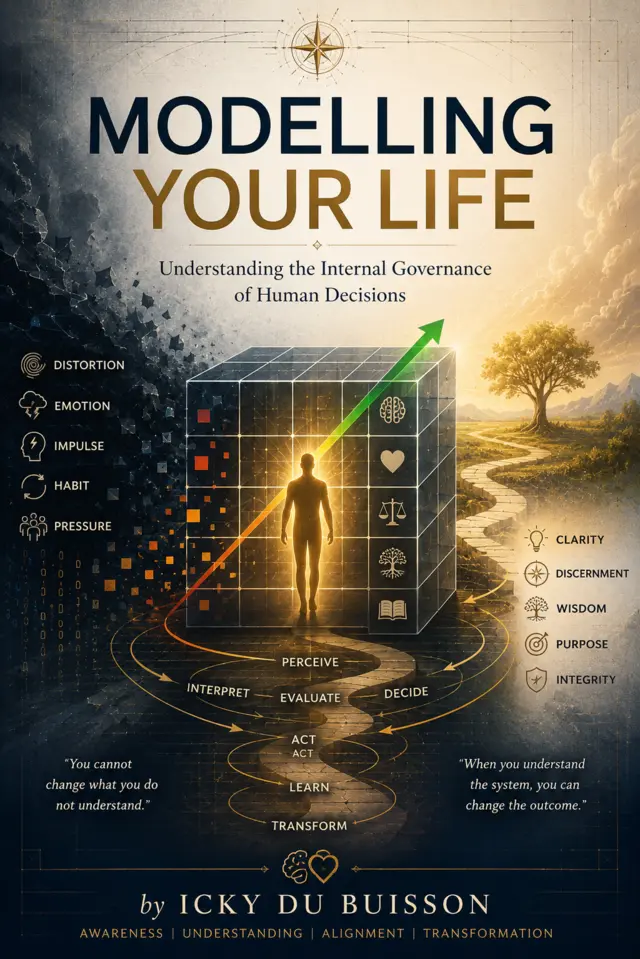
The difference lies in internal governance—the internal system through which a person receives stimuli, interprets information, evaluates meaning, makes decisions, and ultimately acts.
Just as organisations rely on governance systems to guide decisions and ensure alignment with principles and objectives, individuals operate through internal governance structures that shape how they process reality and respond to it. These structures determine whether decisions are driven by truth or distortion, by principle or impulse, by wisdom or conditioning.
This book introduces a framework for understanding and modelling these internal processes. Drawing on concepts commonly used in systems thinking and enterprise architecture—such as context modelling, value chains, feedback loops, and maturity models—the book presents a structured approach to examining how human behaviour emerges from underlying governance mechanisms.
The central premise is simple but powerful: Human life can be modelled.
By modelling the processes through which stimuli are received, interpreted, evaluated, and translated into action, it becomes possible to better understand the forces shaping our behaviour and the outcomes they produce. Once these mechanisms are understood, individuals can begin to intentionally adjust the influences within their environment and internal governance structures to produce different results.
This approach does not attempt to reduce the richness of human life to mechanical formulas. Rather, it provides a framework for insight and discernment—a way to make visible the processes that often operate implicitly beneath our awareness.
The framework developed in this book explores several key components of human internal governance:
- the stimuli that influence a person from both internal and external sources;
- the value chain of human response, through which stimuli are perceived, interpreted, evaluated, and translated into decisions and actions;
- the governance structures that shape how individuals interpret truth and apply principles;
- the maturity levels that reflect different stages of governance development; and
- the feedback mechanisms through which experience modifies future behaviour.
Together, these elements form what can be understood as a Human Governance System—a dynamic system operating continuously within every individual.
By making this system visible, the reader gains the ability to analyse patterns of behaviour, understand why certain outcomes occur, and begin intentionally shaping the conditions that influence their own life trajectory.
This book is therefore not simply about theory. It is about developing the ability to observe, model, and ultimately govern one’s life with greater clarity and wisdom.
The chapters that follow progressively build this framework, beginning with the fundamental components of human beings, their internal governance and expanding toward a broader understanding of how individuals navigate the complex journey from information to wisdom.
The goal is not merely to understand life, but to navigate it more intentionally.
Chapter-level contents
- The Ontology Layer of the Trichotomous Framework
- The Human Response Process
- Internal Governance System
- Governance Degradation and Restoration
- Life System Design
- Annexure A: Data Objects (Consumed and Produced)
- Annexure B: End-to-End Scenario 1—Conflict Situation
- Annexure C: End-to-End Scenario 2—Temptation Situation
Book preview © 2026 Eduan du Buisson, writing as Icky du Buisson. Published by Ashloh. All rights reserved.