This manuscript-derived public article is adapted from the forthcoming book Modelling Your Life. It introduces part of the framework but does not replace the complete Human Response Process, Internal Governance model, worked examples or transformation method in the book.
A response is an outcome of a system
A repeated response can feel immediate and inexplicable: a sharp word, withdrawal, avoidance, impulse, compromise or familiar decision. Yet the visible act is normally the end of an internal sequence. A stimulus is perceived, interpreted and given significance. Emotion or desire is activated. The heart evaluates what matters, a decision is routed, the will commits, action is planned and performed, and the outcome is assigned meaning. Memory is then updated, influencing the next response.
Why visualising the process helps
What remains implicit is difficult to examine. A process model creates enough distance to ask where a pattern was shaped. Was the stimulus accurately perceived? What interpretation was added? Which desire became dominant? What belief or principle governed evaluation? Was the response automatic or deliberate? What meaning was assigned afterward? The model does not turn a person into a machine. It makes relationships visible so that responsibility, compassion and change can be located more precisely.
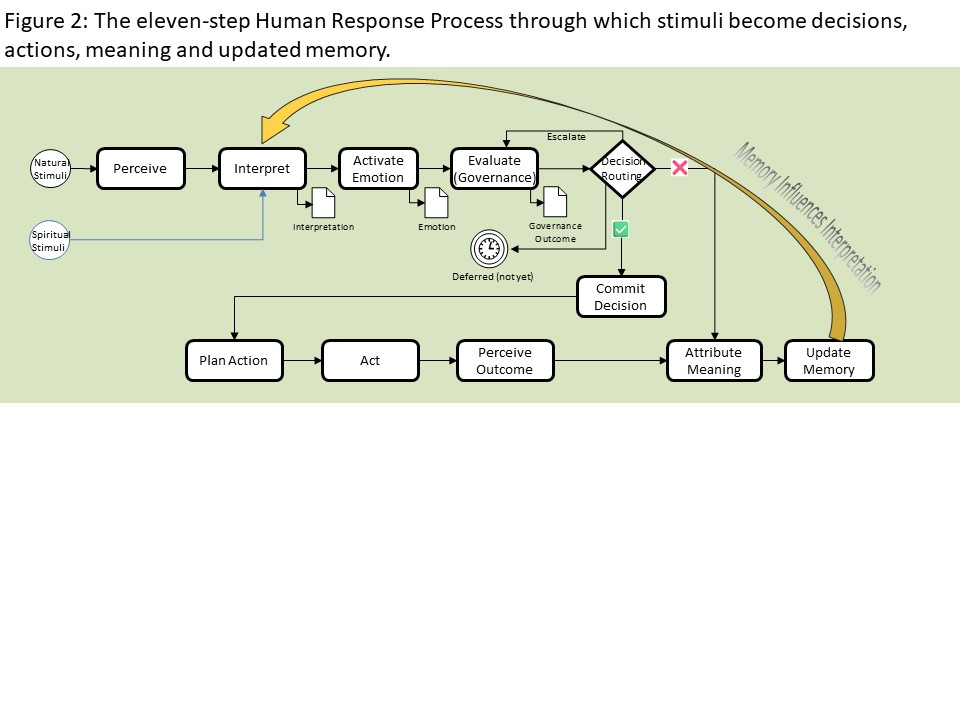
The overview makes the sequence and feedback loop visible. It provides orientation for reflection; the detailed BPMN model can later serve as a separate companion resource for readers who need the underlying process logic.
Open full-size diagram ↗Body, soul and spirit
MYL is written from a Biblical and trichotomous understanding of the human person. The body provides the biological interface through which the person encounters and acts within the natural world. The soul includes capacities such as mind, emotion and will. The spirit concerns the person’s transcendent relationship and responsiveness to God and spiritual beings. These dimensions interact. Fatigue can weaken inhibition, trauma can shape interpretation, beliefs can redirect emotion, and spiritual condition can affect responsiveness to truth.
The Life System surrounding the response process
The eleven-step Human Response Process does not operate in isolation. It functions within a wider Life System that continually influences what a person encounters, how reality is interpreted, what is valued, how decisions are governed and which responses become habitual.
MYL describes this Life System through six interacting dimensions:
- Environment: the people, places, media, circumstances and influences to which a person is exposed.
- Knowledge and mental models: the worldview, beliefs and conceptual frameworks through which reality is interpreted.
- Spiritual state: the person’s relationship and responsiveness to God and spiritual beings, including alignment with truth, sensitivity of conscience and the foundation of identity.
- Principles and preferences: the governing hierarchy that determines whether decisions are led by stable principles or shifting desires and circumstances.
- Habits and neuroplasticity: the repeated patterns that automate behaviour and the capacity of the brain to reorganise through learning, experience and injury.
- Wisdom orientation: whether decisions are governed by truth, discernment and longer-term consequences or by immediate circumstances and desired outcomes.
Together, these dimensions shape the inputs, influences and constraints acting upon the internal governance and response process. A recurring response therefore cannot always be changed by concentrating on behaviour alone. Sustainable change may require redesigning elements of the surrounding Life System as well as strengthening the internal governance through which those influences are evaluated.
When the Life System changes, the conditions that repeatedly produce and reinforce particular responses also change.
Automatic and deliberate modes
Not every response requires conscious analysis. Reflexive and automatic modes are necessary for life and acquired skill. Problems arise when an established automatic pattern continues to govern a situation that requires deliberate evaluation. Under pressure, a person may default to fear, impulse, control, approval or habit before principle is consciously considered. Growth includes recognising when automatic efficiency serves what is good and when deliberate governance must interrupt it.
Internal Governance
Internal Governance describes the regulatory system through which competing influences are ordered. Truth alignment concerns whether recognised truth actually governs evaluation. The power driver concerns what moves the will when alternatives compete. Maturity concerns the stability and integration of the governance system, especially under cost or stress. The heart is not merely emotion; it is the evaluative centre in which beliefs, values, desires and principles converge before commitment.
What to cherish
Not every automatic pattern should be dismantled. Some responses express learned wisdom, disciplined skill, healthy inhibition, compassion, truthfulness or stable principle. Visualisation helps identify these strengths and the conditions that support them. Cherishing a good pattern means understanding how it is sustained, protecting the inputs and relationships that reinforce it, and resisting changes that would weaken its alignment.
What to change
A harmful response may be sustained by more than intention. Environmental triggers, biological instability, emotional injury, distorted beliefs, captured power drivers, spiritual resistance and reinforcing habits can interact. Telling oneself to try harder may briefly suppress the act without altering the system. Change becomes more realistic when the current state is mapped, a target state is defined, gaps are identified and the surrounding Life System is redesigned.
Humans and artificial intelligence
Human and artificial systems can be compared functionally: both receive inputs, process representations, apply constraints and produce outputs. The comparison is useful only if the difference is preserved. AI has a constraint architecture created through data, models, rules, objectives and system boundaries. A human being has embodied personhood, lived meaning, moral agency, conscience, relational responsibility and spiritual accountability. AI can simulate evaluation in output; it does not thereby become a morally responsible human governor.
The danger of outsourced governance
As people rely more heavily on AI, a subtle transfer can occur. The tool begins by assisting with information, then frames alternatives, recommends judgments and eventually becomes an unexamined authority. The central question is not whether AI is useful. It is whether the person remains responsible for testing the input, recognising the system’s limitations, examining the worldview embedded in a recommendation and aligning the final decision with truth and sound principle.
A reflection method
Select one recurring situation. Describe the stimulus without interpreting it. Record what you noticed, the meaning you assigned, the emotion or desire that arose, what seemed most important, what you decided, what you did and how you interpreted the outcome. Then ask what was healthy and should be cherished, what was distorted and should change, which part of the system most influenced the result, and whether any external tool or voice displaced your own responsible evaluation.
From reaction to design
The purpose of modelling is not self-surveillance or self-condemnation. It is responsible visualisation to enable understanding. When the hidden system becomes visible, a person can address causes rather than repeatedly attack symptoms. Environment, knowledge, spiritual state, principles, habits and wisdom orientation can be redesigned and reinforced. Transformation remains human, relational and morally meaningful. The model is a map that supports the journey; it is not the person and it cannot make the journey on the person’s behalf.
From framework to practical application
The Modelling Your Life framework is supported by a practical toolkit designed to help individuals examine their present Life System and define a more intentional desired state.
The toolkit is built around a participant–facilitator model. The participant contributes personal knowledge, lived experience and validation of the findings, while a facilitator—such as a counsellor, mentor or appropriately equipped practitioner—helps the participant interpret patterns, test conclusions and translate insight into responsible action.
The toolkit brings together:
- a structured participant questionnaire;
- a scoring and interpretation engine;
- participant and facilitator reports; and
- facilitation guidelines for supported reflection, validation and Life System redesign.
Together, these components help make patterns of perception, interpretation, emotion, internal governance, decision-making, action and learning more visible. They provide a structured basis for identifying current patterns, considering areas for growth or restoration, and designing practical movement toward a desired future state.
The assessment component may later be made available separately for individual use and voluntary participation in the continued refinement of the framework. The complete participant–facilitator toolkit and its supported-use options will be made available once the delivery model, safeguards and pricing have been finalised.
The toolkit supports structured reflection and guided development. It is not a clinical diagnostic instrument and does not replace appropriate medical, psychological, pastoral or other professional care.