Introduction
This preview presents the book’s purpose and scope. The manuscript remains under development, and the complete book will remain the authoritative integrated work.
We are surrounded by data—endless inputs, updates, metrics, messages, opinions, and digital signals. Never in human history have people had such immediate access to information. Yet, despite this abundance of knowledge resources, we continue to struggle with confusion, poor judgment, division, and unwise decisions.
We see the symptoms all around us: reaction without reflection, decisions without discernment, information without understanding, and knowledge without wisdom.
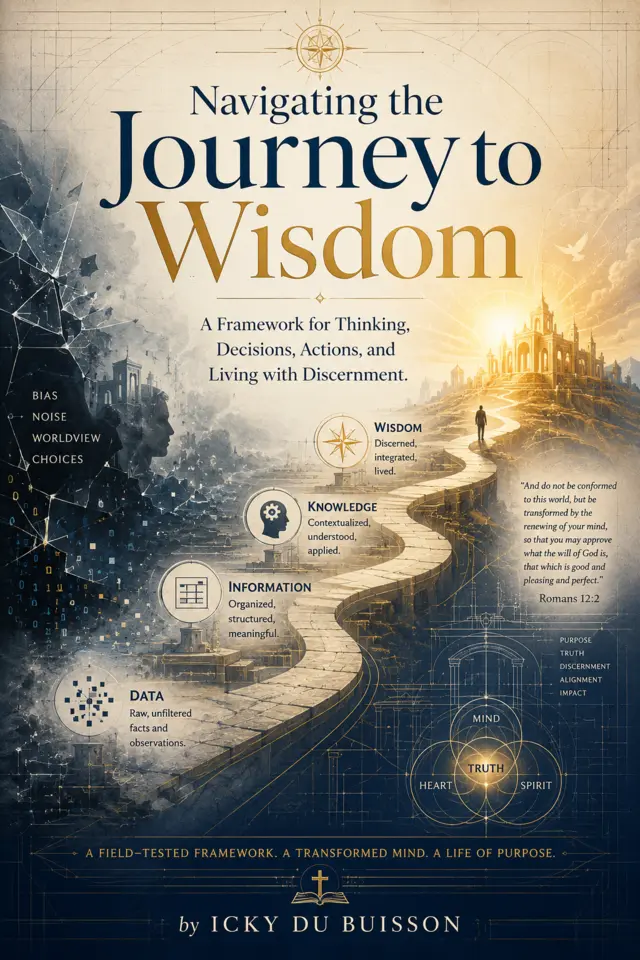
This book is a map for a different kind of journey: a journey from raw data to true wisdom, guided by both architectural principles and spiritual insight.
At the heart of this journey are two frameworks:
- The Data, Information, Knowledge, and Wisdom (DIKW) Hierarchy—a widely recognised model describing how meaning emerges from raw facts and observations.
- The Knowledge Enablement Life Cycle (KELC)—a practical, human-centred framework that demonstrates how data is transformed into information, how information becomes knowledge, and how knowledge is ultimately applied as wisdom.
Unlike traditional knowledge management approaches, the KELC recognises an essential truth: knowledge cannot simply be stored, transferred, or controlled like a physical asset. Information may be provided, but understanding must be developed. Knowledge may be available, but wisdom requires deliberate application.
Human beings are not passive recipients of information. We interpret what we encounter through the lenses of our experiences, education, beliefs, values, emotions, biases, and worldviews. Every message is filtered, every conclusion is interpreted, and every decision reflects something deeper about the person making it.
The journey from data to wisdom is therefore not merely a technical process—it is a profoundly human one.
The Challenge of the Modern Information Age
The modern world presents a paradox. We have unprecedented access to information while simultaneously facing unprecedented challenges in determining what is true, trustworthy, and worthy of action.
Digital technologies, social media, artificial intelligence, and global communication platforms have multiplied humanity’s ability to create and distribute information. These technologies have extraordinary potential to educate, connect, and empower people. Yet they also amplify misinformation, manipulation, ideological conflict, and the deliberate distortion of reality.
The question is no longer simply, “Do we have enough information?” The more urgent question has become, “Can we correctly interpret what we receive, distinguish truth from falsehood, and apply what we know wisely?”
The Knowledge Enablement Life Cycle explores not only how knowledge is created, but also how it can fail.
At every stage of the journey there are opportunities for growth and points of vulnerability:
- Data can be incomplete, inaccurate, or intentionally manipulated.
- Information can be presented without sufficient context.
- Communication can be distorted by noise, ambiguity, or competing agendas.
- Knowledge can be misunderstood because of limitations in ability, experience, or prior assumptions.
- Bias and worldview can shape how reality itself is interpreted.
- Truth can be resisted when it conflicts with existing beliefs or personal desires.
- Knowledge can remain inactive when discipline, courage, or moral conviction are absent.
The greatest barrier to wisdom is often not ignorance—it is the failure to align what we know with what we choose to believe and how we choose to live.
A Journey Through the Knowledge Enablement Life Cycle
This book follows the journey from the creation of knowledge to its application in life.
We begin by establishing the foundations of the DIKW hierarchy and introducing the Knowledge Enablement Life Cycle as a framework for understanding how knowledge is enabled rather than controlled.
We then examine the responsibility of those who provide information—their obligation to collect data accurately, provide appropriate context, communicate ethically, and preserve knowledge for future generations.
The focus then shifts to the recipient: the individual who must search, interpret, understand, and internalise information while navigating obstacles such as communication noise, personal bias, cultural assumptions, and competing worldviews.
The journey continues into the deeper challenge of moving from knowledge to wisdom. This transition requires more than intellectual understanding; it demands judgment, humility, discipline, moral clarity, and the willingness to act according to sound principles.
Throughout the book, we examine practical examples of misinformation, technological influence, social engineering, and real-world decision failures to illustrate how the pathway to wisdom can be strengthened or corrupted.
Finally, we explore practical strategies for becoming better providers and recipients of knowledge—developing habits of critical thinking, ethical communication, intellectual humility, and lifelong learning.
A Journey Toward Wisdom
This book does not present wisdom as a destination that can be reached once and permanently possessed. Wisdom is a continual process of seeking truth, refining understanding, testing our assumptions, correcting our errors, and aligning our actions with sound principles.
The journey requires both knowledge and character. It requires the mind to pursue truth, the humility to recognise its limitations, and the courage to live according to what is discovered.
While this book is written from a Biblical worldview and draws upon Scripture and Christian theology, many of its underlying principles—such as integrity, truthfulness, justice, responsibility, and stewardship—speak to universal human concerns. Whether one approaches wisdom through faith, philosophy, or a sincere desire to live well, the challenge remains the same: to navigate the vast ocean of information with discernment.
The journey from data to wisdom is the journey of becoming a wiser person.
The invitation of this book is simple: do not merely collect information. Seek understanding. Do not merely acquire knowledge. Pursue wisdom.
“And do not be conformed to this world, but be transformed by the renewing of your mind, so that you may approve what the will of God is, that which is good and pleasing and perfect.”
Romans 12:2
Chapter-level contents
- Understanding the Data, Information, Knowledge and Wisdom (DIKW) Hierarchy
- The Knowledge Enablement Life Cycle: From Data to Wisdom
- From Data to Information: The Provider’s Role
- From Information to Knowledge: The Recipient’s Challenge
- Understanding Information—Bridging the Gap to Knowledge
- From Knowledge to Wisdom: Bridging the Gap
- Real-World Applications and Case Studies
- Navigating the Process: Strategies for Success
- Conclusion
Book preview © 2026 Eduan du Buisson, writing as Icky du Buisson. Published by Ashloh. All rights reserved.