This manuscript-derived public article is adapted from the forthcoming book Navigating the Journey to Wisdom. It introduces part of the framework but does not replace the complete argument, models and practical guidance in the book.
The modern information paradox
We live inside a continuous stream of facts, measurements, messages, opinions, images and machine-generated summaries. Access has expanded dramatically, but clarity has not expanded at the same rate. People can possess more information and remain uncertain about what is true. They can repeat accurate statements without understanding them. They can know what should be done and still choose another path. The problem is not only the quantity of information. It is the journey through which information becomes meaningful, becomes integrated into what a person knows, and finally governs action.
Four different things
Data consists of observations or representations that have not yet been organised into a meaningful account. Information emerges when data is selected, structured and placed in context. Knowledge develops when a recipient interprets that information, connects it to prior understanding, tests it, learns it and comes to believe something about reality. Wisdom appears when sound knowledge is applied with judgment, foresight, moral clarity and consistency. These are related stages, but they are not interchangeable. A database contains data. A report presents information. A person may acquire knowledge. Wisdom is demonstrated in how truth governs a decision and a life.
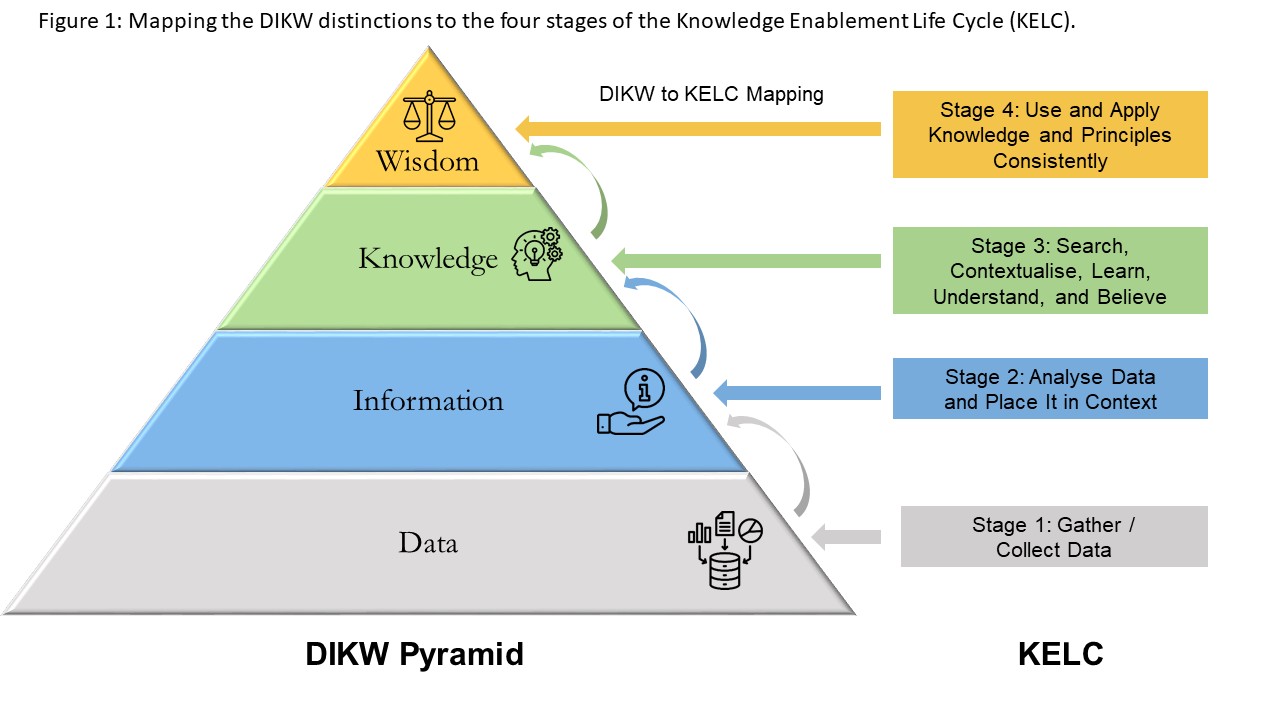
The model shows why collecting and contextualising information are necessary but insufficient: learning and belief enable knowledge, while consistent application of sound knowledge and principles is the movement toward wisdom.
Open full-size diagram ↗Why knowledge must be enabled
Information can be collected, formatted, stored and distributed. The recipient’s understanding cannot be transferred in the same way. Every recipient approaches a message with prior knowledge, ability, attention, experience, language, emotion, motivation, bias and worldview. The provider can improve the conditions for understanding, but cannot manufacture understanding inside another person. This is why the Knowledge Enablement Life Cycle is more accurate than the idea that knowledge itself can simply be managed.
The provider-recipient gap
A provider communicates from one context and a recipient receives from another. Terms that seem obvious to the provider may be unfamiliar or carry a different meaning for the recipient. The provider may omit background knowledge because it feels self-evident. The recipient may lack the conceptual scaffolding needed to place the message. Even accurate content can therefore fail. Ethical provision requires attention to purpose, evidence, context, language, representation, accessibility and the likely needs of the recipient.
Noise, bias and worldview
Communication noise is more than audible distraction. It includes ambiguity, overload, technical complexity, emotional interference, cultural mismatch, channel limitations and deliberate manipulation. Bias influences what is selected, noticed, trusted and remembered. Worldview reaches deeper: it shapes beliefs about reality, knowledge, morality, human nature, purpose and God. No provider or recipient operates without interpretive commitments. Discernment requires us to identify those commitments rather than pretend they are absent.
AI as a mediator of reality
Artificial intelligence adds another interpretive layer between people and the world. It can retrieve, combine and present information at remarkable speed, but its output reflects training data, system design, objectives, constraints and the form of the user’s request. Fluency can create an impression of authority that has not been earned. AI may assist research and explanation; it cannot relieve a person of the responsibility to test claims, examine sources, recognise worldview assumptions and decide what should govern action.
Why knowing is not doing
The movement from knowledge to wisdom is often blocked after understanding has already developed. Fear, desire, pride, social pressure, immediate gratification, emotional intensity and lack of discipline can prevent recognised truth from governing behaviour. A person can explain a principle and still refuse its cost. The knowledge-wisdom gap is therefore not merely intellectual. It involves belief, character, will, moral orientation and the power that actually drives a decision.
A Biblical account of wisdom
Within the Biblical worldview, wisdom begins with proper orientation toward God and truth. Knowledge is not treated as morally neutral possession. The provider is accountable for honesty and care; the recipient is accountable for testing, humility and response. Wisdom joins truthful understanding to righteous application. It requires a renewed mind, teachability, courage and consistency when truth challenges convenience or preference.
A practical reflection
Before accepting or acting on a message, ask: What are the underlying data and sources? What context shaped the information? Who formed the message, for what purpose and through which worldview? What assumptions am I bringing as recipient? What would count as correction? If I accept this as true, what action or restraint should follow? These questions do not guarantee wisdom, but they slow the movement from exposure to assumption and create better conditions for discernment.
The next step
The KELC framework provides a map of this entire journey: gathering data, transforming it into contextual information, enabling learning and understanding, and applying knowledge as wisdom. The complete book develops the stages, failure points, responsibilities and practical strategies in depth. The invitation is not merely to collect more information. It is to become a more responsible provider, a more discerning recipient and a person increasingly governed by truth.